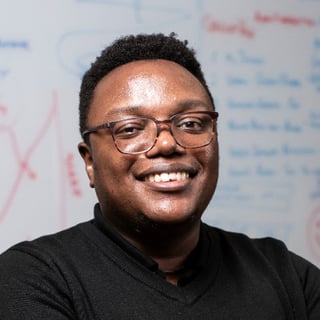
[00:00:00] Mark Murray: Welcome to the OpenAI Forum. [00:00:11] I’m Mark Murray, Editorial Director at OpenAI. [00:00:14] Today’s conversation focuses on how AI is being applied to one of the world’s most difficult challenges: improving health outcomes in resource-constrained settings. [00:00:24] We’ll spend much of our time exploring how AI can help researchers and public health leaders detect, understand, and potentially prevent future pandemics. [00:00:35] More broadly, OpenAI and the Gates Foundation are partnering through a collaboration called Horizon 1000, a pilot initiative with the goal of strengthening primary healthcare for African clinics and their communities. [00:00:49] Today, our focus is on disease modeling. [00:00:52] I’m excited to introduce Geoffrey Mosoti Nyakiongora. He’s the Senior Technical Product Manager, AI at the Gates Foundation, where he works on tools that help governments and health systems make faster, better decisions during disease outbreaks. [00:01:09] His work is shaped by his technical background, by his experience growing up in Nairobi, and by studying why healthcare systems often fail the communities they are meant to serve. [00:01:20] One more thing about Geoffrey: he’s been a member of the OpenAI Forum for about a year and a half now. This is his first time participating in one of our Forum events as the featured guest. [00:01:33] Geoffrey, welcome. Really glad to have you here. [00:01:38] Geoffrey Mosoti Nyakiongora: Thank you, Mark. I’m excited to be here. Thank you. [00:01:42] Mark Murray: I’d love to start with your story. You’ve spent a lot of time studying healthcare systems in places like rural Kenya. Explain why that work is so personal to you. [00:01:53] Geoffrey Mosoti Nyakiongora: It’s a great question. Before I got into this particular role, I was working as an architect. A lot of my work was focused on architectural computation. [00:02:04] I was doing a lot of research on healthcare systems and had the chance to engage with a prominent architect, Rem Koolhaas, who is probably the most prominent architect of the past 50 years. [00:02:21] He was doing a lot of research on the African avant-garde, which is essentially looking at peculiar ways people in sub-Saharan Africa are solving their problems. [00:02:32] During that time, we got a chance to go through Kenya and have a look at how people are engaging with the problems they’re living with. [00:02:40] It was unbelievably eye-opening seeing how fragile our medical infrastructure was. So many people were really suffering. [00:02:49] That precipitated my pull into the research that eventually led me to the work I’m currently doing. [00:02:59] Mark Murray: Excellent. When you think about the communities you’re designing for, what does better healthcare look like on the ground? [00:03:09] Geoffrey Mosoti Nyakiongora: That’s a really good question. Better healthcare can mean a lot of different things to a lot of different people. [00:03:15] In sub-Saharan Africa, it’s really about getting the simple things correct. [00:03:22] I do have some photos to share a bit of context on what I mean by that. [00:03:29] We do have a lot of problems in sub-Saharan Africa. Our healthcare infrastructure is tremendously fragile. [00:03:36] You can see it in photos like this, for example. You can see a lot of people are forced to share beds. [00:03:42] This is not a double-decker. This is a man who’s directly underneath a bed because that’s all the available bed space. [00:03:50] In this scenario, people with non-critical injuries, for example, if you have a broken leg, are forced to share a bed with someone else. [00:03:58] This is particularly common in rural Africa. Same thing as you can see here. This is in Rift Valley. [00:04:06] You see a lot of people who are unfortunately very unwell, but the medical infrastructure is barely keeping up. [00:04:14] In the saddest cases, you can see these are two women who have just given birth and were forced to share beds. [00:04:21] They’re in a very vulnerable state, and the situation is tremendously dire. [00:04:28] It’s the same thing here as well. If you have non-critical injuries, you’re forced to share a bed, and in most cases, you’re hurried along in your recovery process. [00:04:41] A lot of people don’t necessarily heal well. It’s a very dire situation. [00:04:49] Mark Murray: Geoffrey, thanks for sharing. Those are really powerful photos. [00:04:52] Geoffrey Mosoti Nyakiongora: Thank you. To bring it back to the question, it’s just about getting the basic things right. Do we have medical equipment? Do we have beds available? What’s the capacity of our hospitals? Can we accommodate more people? [00:05:07] I think the pandemic exposed how fragile it is for a lot of people in sub-Saharan Africa. [00:05:18] Mark Murray: Speaking about pandemics, when most people think about public health crises, they think about COVID. They may also have recently read about Hantavirus and Ebola. What did COVID teach us about how quickly public health leaders need to understand and respond to an outbreak? [00:05:35] Geoffrey Mosoti Nyakiongora: It taught us a lot of things. The two things that immediately come to mind are, number one, you can go from an emergent threat to a global crisis within the span of not just months, but weeks. [00:05:50] I think everyone’s life was upended in 2020 within the span of just a couple of weeks. Schools closed, there were heavy travel restrictions, and our hospitals were absolutely overwhelmed. [00:06:05] It meant that a lot of people, and a lot of professionals going through this first generational pandemic, realized that systems can be subverted within a matter of weeks. [00:06:24] We can’t wait for the pandemic to happen before we start making interventions and doing modeling. We have to be preemptive about this. We have to anticipate what will happen and do it very early on. [00:06:40] The second thing the pandemic exposed is that our medical infrastructure is pretty fragile. We lost a lot of people to COVID. Within a span of four years, 7.1 million people died. In the U.S., 1.1 million people died, including 300,000 people in 2021. [00:07:00] It was a really eye-opening situation. It means we have to prepare before the pandemic happens. [00:07:10] Mark Murray: Let’s talk about AI’s role in all of this. How did AI-enabled modeling help teams track what was changing during COVID and where the virus could spread next? [00:07:21] Geoffrey Mosoti Nyakiongora: At the Foundation, we have three existing modeling frameworks. The first one is called EMOD, which is what the Foundation has been doing for quite some time. It’s been developed over the past 15 or so years. We have Starsim, and we have LASER. LASER is a lightweight agent-based spatial modeling tool. [00:07:40] AI became absolutely fundamental during the development process for Starsim. We built a simulation model called Covasim, so COVID plus Starsim gives you Covasim. [00:07:55] Covasim was tremendously versatile. It was used by the governments of Washington and Oregon for policy planning. Everything from physical interventions to diagnostic interventions to pharmaceutical interventions was modeled on Covasim, and decisions were made about things like how many masks to issue and how many vaccines to issue. [00:08:26] That was highly precipitated by AI and machine learning as well. We played around with a number of machine learning models and AI tools, and this has only improved as time has gone on. [00:08:40] The frontier models we have now, including GPT-5, are tremendously powerful. There’s so much that’s being done. [00:08:51] Mark Murray: I’d love to hear more about the advanced models and what they can do now, compared with what you were doing just a few years ago. Can you provide some specifics on what they’re able to do? [00:09:05] Geoffrey Mosoti Nyakiongora: They can do a number of things, all the way from surveillance. We can use our models to assess data and use that data to identify whether there are variances that mean an outbreak is about to happen or is currently happening. [00:09:33] We’re also using AI models to make these simulation models more accessible to people. For example, we’re building MCP servers that several people can access. You don’t necessarily have to be unbelievably technical to query a simulation model. That was not possible six years ago. [00:09:56] I’ll also throw in one additional one: calibration. Calibration is a tremendously difficult task. It takes months upon months to get done. But with the AI tools we have, we’ve built skills and agent workflows that make it much more accessible to different people. [00:10:19] That’s just skimming off the top. There’s so much more we’re using AI for, and it’s really exciting. [00:10:29] Mark Murray: Let’s talk about one other subject AI can be used for here, which is helping public health teams prepare for the next pandemic. How does AI figure into that? [00:10:41] Geoffrey Mosoti Nyakiongora: The biggest thing we’ve learned is that pandemics can affect different populations differently. That sounds obvious, but when a pandemic is happening, it can be really daunting. [00:10:56] The quality of healthcare you will receive in, for example, Washington or San Francisco is vastly different from places like sub-Saharan Africa, where I am, and the photos show that. [00:11:11] To prepare for the next pandemic, we have to enable teams in LMIC countries as much as possible. [00:11:21] The technical hurdles to making these models accessible to different people have never been lower. The way we’re approaching it is by making these tools accessible through MCP services, using natural language to query these models, and using data visualization inputs so people can engage with these models very easily without necessarily knowing how to code. [00:11:52] These are some of the ways we’re making it accessible so that people in different locales, different locations, and researchers all over the world can access these models very easily. [00:12:05] Mark Murray: Geoffrey, you talked about data visualizations. Predicting the next health crisis depends on strong data. How is AI helping teams collect, strengthen, and make better use of that data? [00:12:15] Geoffrey Mosoti Nyakiongora: Data collection is an essential part of everything we do, and sometimes the quality of data is not always consistent. Sometimes you get sparse data, and sometimes you get datasets that are robust and can be used in a number of different scenarios. [00:12:35] We’re using AI in a number of interesting ways. For example, literature search. If you want to source data from a particular source, we’re using AI to source that data and ensure that it meets a particular criterion. Something that would otherwise have taken several months can be done within a couple of hours. [00:13:01] In scenarios where the data is tremendously sparse or not complete, we can use machine learning models to fill in those gaps and prototype quickly because of the gaps we filled. [00:13:16] This doesn’t just say whether the data is accurate or not. It helps us understand what we can do with it. [00:13:23] Mark Murray: You mentioned how quickly things can go. Where is AI helping teams move faster the most, from finding patterns to testing scenarios to sharing insights sooner? [00:13:35] Geoffrey Mosoti Nyakiongora: I think it’s definitely in finding patterns, and also going back to the previous question, in scenarios where you have sparse data. You have sparse data more often than you have complete datasets. [00:13:49] With AI, we can assess the quality of data tremendously quickly. That enables us to build prototypes really fast. [00:13:59] For example, I was starting off a new project and speaking to a researcher last week. I was asking him how he’s engaging with frontier models. He told me that now that he has tools like Codex, and I’m going to focus on Codex because that’s what he actively uses, he knows he will never go back to handwriting code. [00:14:25] That means he can prototype tremendously fast, test out a research question, and iterate. You can iterate super quickly. [00:14:37] That’s been tremendously important to him because he can test and validate a number of research questions within a very short timeframe. [00:14:48] Mark Murray: Geoffrey, there’s a difference between modeling an outbreak and helping people act on that information. What needs to happen for AI-enabled modeling to help public health leaders make decisions on the ground? [00:14:59] Geoffrey Mosoti Nyakiongora: A number of interesting things could happen, but the most important thing is acknowledging that people have different approaches and different resources to solve these problems. [00:15:13] AI has lowered the technical hurdles significantly, especially over the past three years. What we’re thinking about is: can we offer the same modeling tools that we use in Seattle, San Francisco, or Washington, D.C., and offer them to researchers in Kinshasa, Nairobi, or Cape Town? [00:15:41] The way we’re thinking about it is: can we go beyond natural language? Natural language is powerful because you can type in a query to a model and get insights from that. But something even more powerful is: can we transfer the expertise from a researcher in San Francisco, in a well-resourced environment, encode that knowledge, and then transfer it to somebody in a resource-constrained environment? [00:16:16] AI is enabling that now more than ever before. It’s very exciting because it’s making a lot of things possible that were initially very far from reach. [00:16:27] Mark Murray: Geoffrey, give me an example of how you’re able to transfer the knowledge of a technical specialist to somebody elsewhere in the world who is trying to mitigate these outbreaks. What are some specifics? [00:16:44] Geoffrey Mosoti Nyakiongora: With the work we’re doing right now with Covasim, HIVsim, and Malariasim, because we’ve had a couple of malaria outbreaks over the past few years, what we are recommending is, number one, creating a foundational framework that will enable us to build AI tools: getting the right data, creating the right pipelines, and the like. [00:17:08] Then, on the application layer, we’re trying to create skills, agent skills, and agents themselves that embody best practices. [00:17:21] Number two, they can enable people to create scientifically valid output. Scientifically valid output is tremendously enabling because scientific processes are rooted in scientific method and reasoning, both inductive and deductive reasoning. [00:17:47] If we can encapsulate that knowledge into a skill and create outputs that we know guarantee a systematic, consistent resolution that is reproducible, that is almost like magic for me. [00:18:08] That’s powerful because I know if I can create an agent or an agent skill that produces a consistent answer time after time, I can share that with anyone across the world, and they can produce the same results. That is tremendous. [00:18:23] That could potentially save thousands upon thousands of lives. That’s really exciting. [00:18:33] Mark Murray: What kinds of decisions could public health leaders make earlier if these data-informed insights become more widely accessible? You talked about how they allow people to move from technical experts to broader users, but how much faster could you get insights? [00:18:53] Geoffrey Mosoti Nyakiongora: It could be significantly faster. For example, at the Foundation last week, we were testing out a new calibration tool that was built by two absolutely incredible researchers on our team. [00:19:08] They took the calibration process from what they initially anticipated would take three months and compressed it to five days. [00:19:24] They can come out with really solid results through history matching, through the calibration tool they designed using agent skills. That means people can reach their insights tremendously quicker. [00:19:39] Because these skills and agents exist, you can test out a number of different hypotheses in a number of different ways. [00:19:49] Going back to the point on lowering the technical hurdle, it also means that beyond natural language, you can make alterations to these simulation models very quickly. [00:20:02] Some researchers are comfortable with R, but not necessarily familiar with Python, for example. You can do code migration with Codex or ChatGPT really quickly. You can learn insights tremendously quickly. [00:20:17] That means that if another pandemic happens, God forbid, I think we’ll be significantly more prepared because we do have AI tools. Now that the bells have been rung, they can’t be unrung, and I think that’s a good thing. [00:20:33] Mark Murray: When you talk about the next pandemic, looking at how quickly the models have improved and what we’re able to do now, where do you think disease management and outbreak mitigation will be five years from now? What do you think the world looks like? [00:20:50] Geoffrey Mosoti Nyakiongora: So many interesting things there. One thing is we’ll be able to build prototypes a lot faster, so we can make policy decisions super quickly. [00:21:04] Number two, I think we’ll be significantly more prepared. [00:21:07] Whatever the pandemic turns out to be, I think people will be so enabled by AI tools that they’ll be able to quickly draw insights, revise their strategies, and recommend government interventions that are particularly catered to the communities they are serving, which could potentially save millions upon millions of lives. [00:21:30] I also foresee that the surveillance portion of modeling will be a lot quicker. People will be able to detect a pandemic tremendously quickly based on the data they have and the opportunities that machine learning and AI are enabling us to draw insights from. [00:21:56] Mark Murray: Now let’s move from your technical expertise to the OpenAI Forum itself. You and I were discussing that you’ve been a member for a year and a half. What have you gained as a member of the OpenAI Forum, and what are some of your favorite discussions you’ve had so far? [00:22:12] Geoffrey Mosoti Nyakiongora: So many fantastic conversations, so many brilliant speakers. I’m sure the chat, too. I’ve met so many interesting people through the chat who I keep in touch with even outside the Forum. They’re all doing tremendously interesting things. [00:22:32] Every time I come in for a chat, I gain insight. I think about AI in a way I never thought about it before. [00:22:39] I’ve been touched on a personal level by some of the stories shared through the Forum. I’ve had my own health issues, and seeing how people are using AI to help them navigate the treatment process through some of the medical issues they are also going through has been really impactful and insightful. [00:23:06] It touched me on a personal level, and every time I attend, as I was telling you, Mark, I think I’ve attended 85% of the sessions that have been available. I’ve learned so much. [00:23:20] Mark Murray: Geoffrey, thank you for sharing those personal stories. I hope some of our listeners are getting great insights that they’ll be able to share on the Forum and with the other members of the OpenAI Forum. [00:23:33] Before we open up to Q&A, Geoffrey, I’d love to end on a high note. Bill Gates has described the Foundation’s work through the lens of “impatient optimism.” What makes you optimistic about the role AI could play in preventing the next health crisis? [00:23:49] Geoffrey Mosoti Nyakiongora: Really interesting. Just credit to Bill: Bill is unbelievably enthusiastic about AI. Whenever he comes in for a presentation, almost in the past three presentations we’ve had, they’re called Gates Sessions or Gates Reviews, he always sneaks in something on AI. [00:24:14] That enthusiasm is infectious, so everyone is also excited about using AI. [00:24:21] I think the enthusiasm comes from us knowing that these tools are helping us get insights so much faster. That could potentially mean so many more lives saved in the future. [00:24:36] I don’t know how that can’t be exciting to anyone. The fact that you have tools that enable you to do work even better, and potentially save people’s lives, is exciting. [00:24:50] Mark Murray: That’s really well put. Thank you. [00:24:50] All right, let’s get to the questions. They’re starting to roll in. [00:24:56] We have one from Daniel Green, who’s the lead of the Kansas City AI Collective. Geoffrey, he asks: what’s one project where LLMs and tools like Codex let you do something you simply couldn’t have done before? [00:25:11] Geoffrey Mosoti Nyakiongora: Several things. I mentioned the calibration process, which is tremendously complex, needs a ton of data, and needs quite a bit of expertise. It’s a process that used to take us several months. Truncating that into a couple of weeks, and in some cases days, is unbelievable. [00:25:36] Something else, maybe a bit simpler, is how simply you can build a wrapper that translates R into Python and vice versa. That’s genuinely amazing. Or you can analyze several different datasets in one go without necessarily needing a supercomputer. [00:25:55] It blows my mind that these tools weren’t here five years ago, or weren’t publicly available. [00:26:01] We used to rely on a lot of compute. We needed quite a bit of technical expertise and had to try out several machine learning methods to get to the results we currently have. All that has been compressed into really powerful tools. [00:26:22] Mark Murray: The next question comes from Jose Lizarraga. He’s a researcher at the UC Berkeley School of Education. He asks: given lessons from COVID, how can education and trust-building help communities understand, trust, and act on AI-driven pandemic warnings before the next public health crisis? [00:26:44] Geoffrey Mosoti Nyakiongora: Super interesting question. Also a Berkeley alum, so thank you for that question. [00:26:52] For education, the AI tools have, going back to my point, lowered the technical hurdle now more than ever before. That means we have the opportunity to teach people on the go tremendously fast and cater our responses to particular problems. [00:27:21] We can cater our solutions to the problems and adapt them tremendously well. In the event of a pandemic, for example, social distancing was a particularly new thing, as was how to wear a mask. [00:27:36] We have AI tools that, number one, can do language translation quickly and easily. Number two, we can adapt to different contexts. Number three, we can understand cultural nuances as well. [00:27:44] Essentially, AI enables us to cater a message to different audiences in a personalized way, which is really empowering. [00:28:00] Mark Murray: Continue to get your questions in, but here’s another one from Jason DeLuca. He’s the owner and principal consultant at Crossing Point IT Solutions, LLC. [00:28:12] Jason asks: how can AI pre-bunk panic, unproven treatments, and downplayed risk while separating coordinated manipulation from real scientific debate? [00:28:24] Geoffrey Mosoti Nyakiongora: Really hard question, but also really interesting. I think the powerful thing about the models we have is that they are open source and accessible. They’ve been built by building a lot of trust with our partners. [00:28:44] These models are built over several years, and they’re robust. It takes a lot of collaboration to enable these models to be accessible. [00:28:58] To answer his question directly, an important part AI will play in building trust is going back to what I was saying: we have these technical experts, these amazing researchers working in collaborative environments to build robust models. [00:29:22] We want to ensure that these models are accessible to everyone once they are released. [00:29:33] We build within an open-source community, and AI has enabled these tools to be accessible to everyone because the technical hurdle is lower. [00:29:42] On the element of trust, I think trust is built over time. It’s not necessarily built through tools alone or technology alone. As much as we have these technological advancements, there is an element of trust-building that comes through relational engagements with people, governments, and the like. [00:30:07] Mark Murray: That’s well put. Thank you, Geoffrey. [00:30:09] All right, another question. This comes from Svetlana Romanova, who asks: could AI forecasting models include early behavioral and social signals while also distinguishing personal behavior from structural barriers? [00:30:24] Geoffrey Mosoti Nyakiongora: Very interesting and complicated question. This is something we’ve been talking about quite a bit in the office. [00:30:31] How do you embody cultural and social nuances in the models we’re building to make them more robust? [00:30:39] As the models exist at the moment, yes, there are some cultural nuances embodied in these models, but they’re not as robust. Going back to our modeling frameworks, the three we have are agent-based models, and they are also stochastic, so they’re non-deterministic. [00:30:57] We recognize that is one component and only one way of solving a problem. [00:31:02] Is there a way we can use different data sources and different modeling techniques to create a more holistic answer that saves lives and solves difficult problems? The answer is yes, and this is something that is only possible now that we have AI. [00:31:33] For example, right now I’m in Nairobi. We’re working with one of our grant partners called CEMA, and they were asking themselves the exact same question: why is vaccine uptake in some communities not as high as others? How do economic nuances play into how people engage with vaccines, for example? [00:31:52] They built MCP services to try to answer this question. [00:31:59] So you have a financial model, an epidemiological model, and a cultural model. How do I draw insights from those three things to give me a holistic answer? It’s not a particularly easy thing to answer, but yes, it’s something we’re definitely thinking about and testing out. [00:32:20] Mark Murray: Excellent. Here’s the final question we have, from Angela Jimenez, a physician leader at Lyon Health. She asks: have you included real-world data in your databases? And if so, could you please describe the components that make your databases functional? [00:32:33] Geoffrey Mosoti Nyakiongora: Yes, we do use real-world data. Data comes from a number of verified sources, and this is something we take particularly seriously. This is across all our models. We take it tremendously seriously. [00:32:59] Mark Murray: I think I lost you there during the second part of the question. The second part is: if you include real-world data, could you please describe the components that make your databases functional? [00:33:15] Geoffrey Mosoti Nyakiongora: Our databases and our data are from a number of verified sources. In some cases, for example, it’s ministries of health giving us this data. It’s from universities that have been engaging with these research problems and research questions for several years. [00:33:38] There is a tremendous amount of veracity in who we source the data from and how we use that data. [00:33:47] Just an added layer to this: the foundational component for any machine learning model or any AI model, for that matter, is data. Data is absolutely fundamental. Even before this AI age, and now that we are in it, data is something we took very seriously and still do. [00:34:17] Mark Murray: Geoffrey, thank you for this illuminating discussion. It’s been a real pleasure chatting with you. [00:34:23] It’s great to hear that you’re a longtime member of the OpenAI Forum. Now we get to chat with you, and I think a lot of Forum members who are listening in, live or on replay, are going to be inspired to think about whether their next turn might be as a guest at the OpenAI Forum. [00:34:41] Geoffrey Mosoti Nyakiongora: Thank you so much, Mark. I’d also like to say thank you to several different Forum members, and also your team, the OpenAI team. [00:34:50] Thank you, Mark, and also Natalie Kuhn, Caitlin, Mimi, Noah, and Sam as well. Sam has been a bit of a mentor to me. While I was still at MIT, Sam was invited to speak to students at MIT and Harvard, and I couldn’t get into the main audience hall. [00:35:09] So I sent him an email and told him it would have been lovely to catch up with him. He replied within two days, and we’ve been connected ever since. He’s been a tremendous mentor, to put it that way. [00:35:23] Thank you for the community, the Forum, and I’m super excited. [00:35:31] Mark Murray: I love hearing that, Geoffrey. Thank you very much. Goodbye, and we look forward to hearing from you again. Thank you so much. [00:35:38] Geoffrey Mosoti Nyakiongora: Thank you. [00:35:40] Mark Murray: And just for the community, thank you so much for joining this edition of the OpenAI Forum. [00:35:45] On June 2, we’re going to have OpenAI’s CFO presenting the future of finance with the University of California’s Chief Investment Officer. The conversation will focus on why the UC System invests in AI, how AI can augment finance skills, and why judgment and analysis are becoming increasingly important. [00:36:05] We’re going to have many more events like that down the pike. Please join us, and as always, thank you for listening.