

Event Recap
June 26, 2026
What We Learned at the OpenAI Forum on Building the Future of AI
# AI Safety
# AI Science
# AI security
Lessons from the convening

Jason Pruet
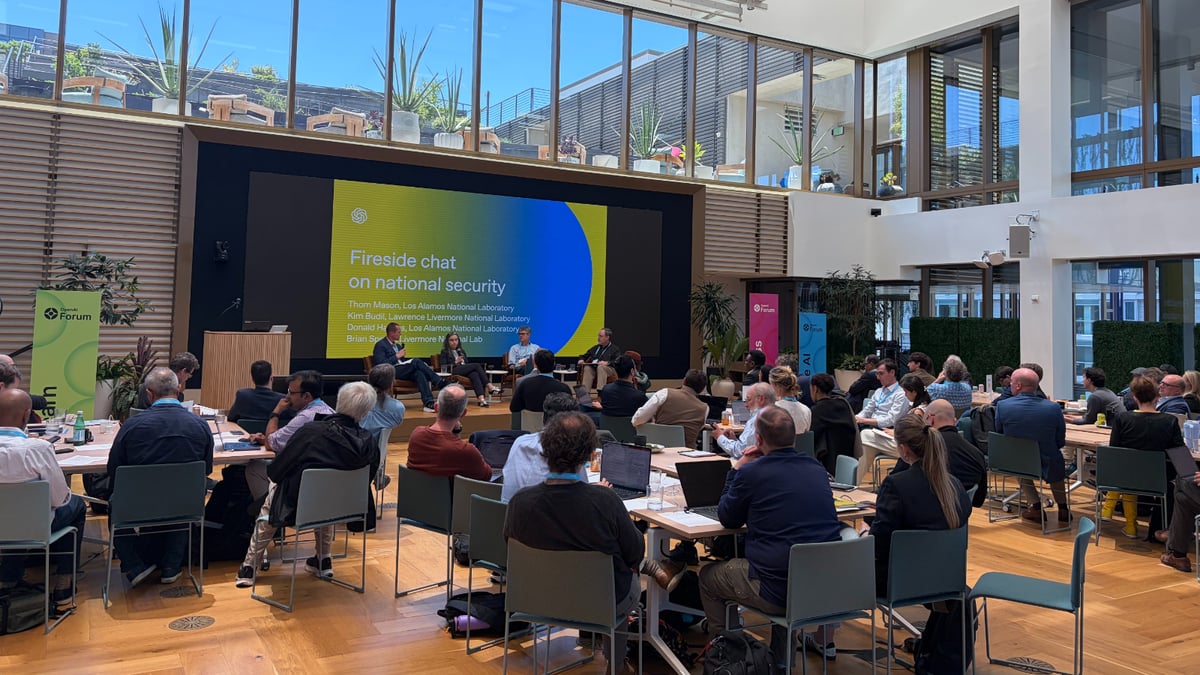
On June 17, leaders from philanthropy, the national security community, universities, and healthcare came together in San Francisco to help chart a common course for harnessing the potential of frontier AI. At OpenAI, we believe that learning how to use and work with AI is one of the most urgent needs of the intelligence age. AI models are changing so quickly that our collective understanding of how to use them isn’t keeping pace. We are all just starting to figure out how to use AI at scale to tackle humanity’s most important challenges, from curing disease to strengthening the security of nations.
The speakers offered deep insights into what is now possible using frontier AI, including OpenAI’s most advanced models.
- Gabriel Manso of MIT FutureTech described an evaluation of whether frontier AI could independently reproduce difficult scientific papers it had never seen. He found that, with the GPT-5 series of models, this had recently become possible for many papers.
- Rick Stevens of Argonne National Laboratory showed how AI agents can help reproduce published research. The agents read a paper, build working environments on a computer, write and run code, and test whether the evidence supports the paper’s conclusions. This opens the possibility of checking the reproducibility of science to help researchers avoid false leads and build on firmer ground.
- Adam Goff of Renaissance Philanthropy described using AI to sift through millions of ideas in areas such as antimicrobial resistance, nutrition, and air quality, searching for overlooked possibilities with enormous potential.
- OpenAI’s Tobias Peyerl offered a security perspective. His team is using large numbers of agents to examine suspicious material and organize evidence so that people can detect and stop bad actors.
- Neil Thompson of MIT gave an economist’s perspective on why these advances matter. He presented studies indicating that with the models available today, we have the potential to accelerate innovation. Innovation is one of the great sources of economic growth and prosperity. If AI can accelerate research, societies will have greater capacity to improve the lives of their people.
The discussion then turned from AI’s potential to the actions needed to translate those capabilities into broad benefits for the world. After examining the potential of AI, the speakers considered what it will take to realize the broader potential of AI. Pat Fitch of Los Alamos gave insights from an earlier transition that at the time was also considered disruptive. Just over 25 years ago the human genome project started. This replaced laborious sequencing work with rapid automation. At the time we faced many of the questions we do today: concerns over security, the fear that people have of losing fear of losing their role, and mistrust of technology. Making progress will depend on a culture that embraces change at scale.
Professor Lav Varshney of Stony Brook and Kocree emphasized the need for a sociotechnical perspective, in which society and technology are understood as parts of one system. Drawing on his experience in both AI research and public policy, he stressed the need to stop viewing AI simply as a better version of something old but to reimagine it on its own terms. New capabilities require new institutions, new policies, and new foundational ideas for performant and safe AI technologies.
The forum working groups examined what those changes could look like.The national security group called for shared horizon scanning, because governments, societies, and frontier AI labs need a common picture of where technologies are heading. Better awareness would help institutions prepare for changes in capability rather than experience them as repeated shocks.
Materials scientists discussed challenges that may be especially well-suited to a combination of AI and high-performance computing. These included superconductors that work at high temperatures and near ambient pressure, stronger magnets, and the difficult problem of predicting how promising new materials can be synthesized. There is no guarantee of a breakthrough. But Rus Hemley of the University of Illinois Chicago suggested that using AI to fill longstanding gaps in the quantum foundations of materials theory could create a new ability to design materials rather than discover them largely through trial and error.
In biology and medicine, participants explored how frontier AI could make research more predictive, moving beyond the description of biological structures toward anticipating how living systems will behave. They discussed using AI to determine what proteins do, how they interact with other molecules, and how those interactions influence cells and disease. More ambitious possibilities included building “world models” that simulate cells across multiple scales, enabling researchers to test ideas computationally before undertaking costly laboratory experiments. Other ideas included using AI to propose new biological mechanisms, design more powerful scientific instruments, and create entirely new theories for researchers to test
In the afternoon, Kim Budil and Thom Mason, the directors of Lawrence Livermore and Los Alamos National Laboratories, placed the forum in a larger historical context. Beginning in the early twentieth century and accelerating during the Second World War, science increasingly became a large-scale national enterprise. It brought together the combined strength of nations to pursue ambitious goals. This era of “big science” allowed us to reach outer space, extend human lifespans, and feed growing populations. By advancing the frontiers of knowledge and making the benefits of those advances broadly available, much of the world prospered.
Budil and Mason argued that AI will set off another acceleration of this kind. By helping scientists work faster, explore more possibilities, and tackle problems that once seemed out of reach, AI could lead to a growing cycle of discovery. Nations and institutions that learn to use frontier AI effectively at scale will be better positioned to benefit from that progress, while those that do not may fall behind.
There is a lot of work ahead. Making full use of frontier AI will require a broad community working together over years. But this is also a generational opportunity. We have a chance to accelerate discovery, strengthen societies, and solve problems that have seemed beyond our reach just a few years ago.
1
Comment (1)
Popular

Dive in
Related
1:07:37
Video
Careers at the Frontier: Hiring the Future at OpenAI
By Joaquin Quiñonero C... • Jul 25th, 2025 • Views 7.8K
1:07:37
Video
Careers at the Frontier: Hiring the Future at OpenAI
By Joaquin Quiñonero C... • Jul 25th, 2025 • Views 7.8K