About the Talk
AI is quickly becoming a strategic advantage for nations. For the United States to stay ahead we need to broaden the conversation beyond software, to include the physical infrastructure that powers AI, including advanced chips, energy, data centers, and the compute needed to train and run increasingly capable systems.
Join the OpenAI Forum for a timely conversation about why AI infrastructure matters to U.S. competitiveness, economic growth, and national resilience. We’ll explore how investments in computing capacity and related infrastructure can help drive breakthroughs in areas like healthcare, can support innovation in new industries, and ensure the United States remains a global leader in the next era of technology.
The discussion will also examine what it takes to build this future responsibly in partnership with local communities, balancing speed, security, sustainability, and broad access so the benefits of AI reach more people. Whether you’re interested in technology, policy, business, or the future of the economy, this conversation will offer a clear and practical look at one of the most important issues shaping the AI era.
About the Speakers
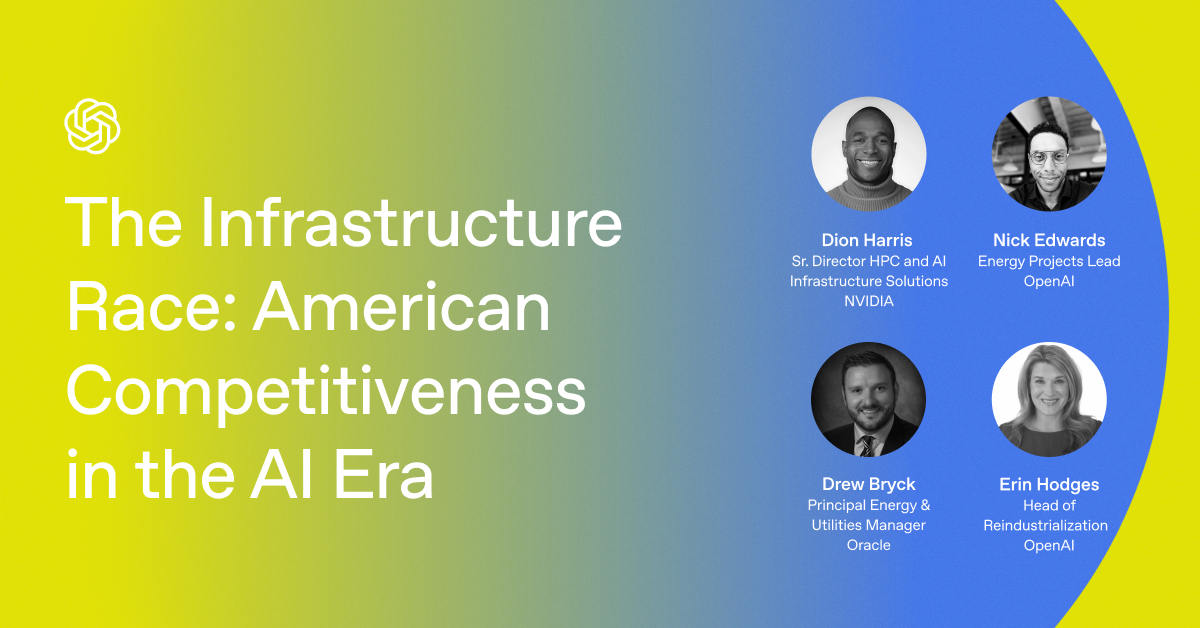
Dion Harris, Senior Director of HPC and AI Hyperscale Infrastructure Solutions at NVIDIA. Harris is focusing on driving product strategies for HPC and AI hyperscale infrastructure solutions. Before joining NVIDIA, he held various product management and product marketing roles at data center technology companies such as Dell EMC and Symantec. He holds a bachelor’s degree in economics from UC Berkeley and an MBA from UC Berkeley’s Haas School of Business.
Nick Edwards is Energy & Power Projects Lead at OpenAI, Industrial Compute. He drives the development of multi-gigawatt power and infrastructure programs to enable the scaling of frontier AI. Working at the intersection of energy strategy, markets, site selection, policy, and physical infrastructure enablement, he focuses on solving grid and infrastructure constraints while aligning rapidly growing AI demand with real-world power systems. His work spans power generation, transmission, permitting, development, large-load siting, and grid integration across U.S. and international markets. At OpenAI, his work is focused on a central question: whether AI will be constrained by legacy grid architecture, or help drive a new model for how energy, infrastructure, and compute are planned and built.
Drew Bryck is a sustainability and energy strategy leader focused on large-scale utility infrastructure, renewable energy procurement, and hyperscale data center growth. He currently serves as Principal Energy & Utilities Manager at Oracle, where he leads grid, generation, and tariff negotiations for GW-scale data center development. Prior to Oracle, Drew held energy strategy and infrastructure roles at Salt River Project, Intel, and Boeing, specializing in renewable energy contracting, utility negotiations, and corporate sustainability initiatives. His work spans clean energy deployment, data center infrastructure, and utility-scale power strategy, with a focus on enabling reliable, cost-effective energy systems for rapidly growing industries. Drew holds both an MBA and an MA in Sustainability and Public Policy from Arizona State University.
Erin Hodges is a campaign and public affairs leader at OpenAI focused on the intersection of AI infrastructure, economic development, energy, and local communities. As part of OpenAI’s Global Affairs team, she leads major reindustrialization and infrastructure campaigns across the U.S., helping shape partnerships around data centers, energy, workforce development, and manufacturing. Prior to OpenAI, Erin served as Senior Advisor to Texas Governor Greg Abbott and held in-house government affairs roles across multiple companies, where she focused on public policy, legislative strategy, stakeholder engagement, and navigating complex state and local issues.