From11:30 AM
To12:00 PM
PST
Tags:
IRL Guest Check In
Security Check in for IRL Guests
+ Read More
HYBRID
Main Stage7:30 PM - 8:00 PM GMT


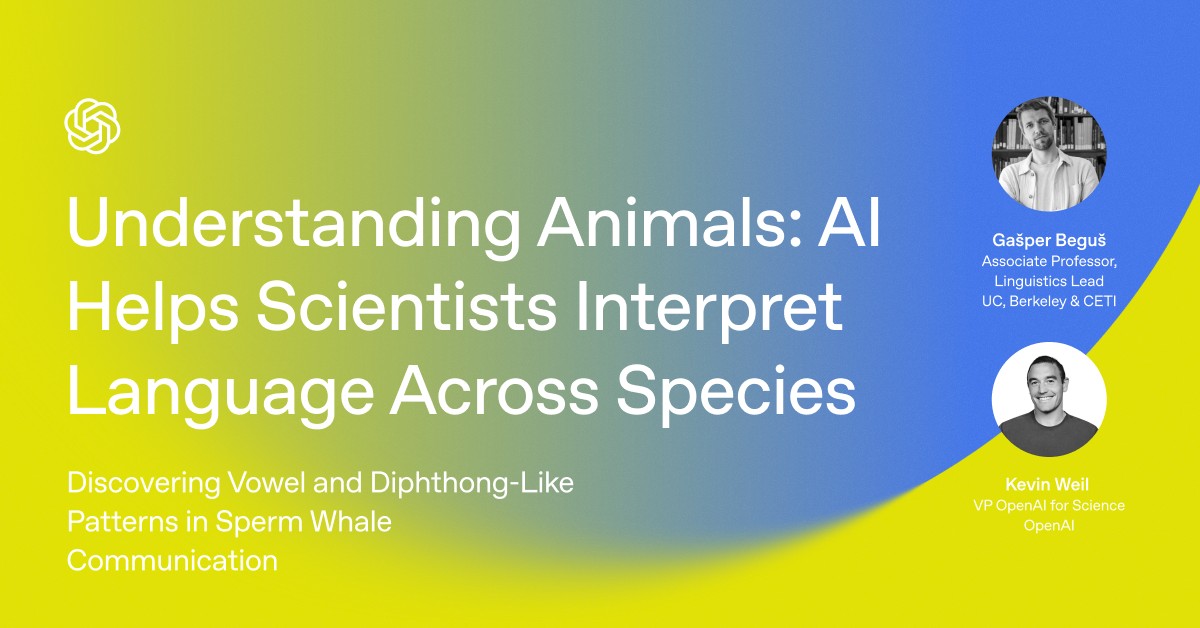
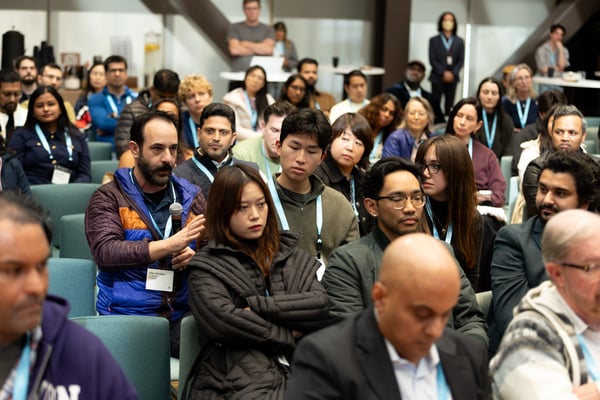
This OpenAI Forum will unfold in 2 parts. During our OpenAI Forum, we’ll feature two distinct but related talks.
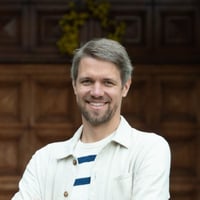
First, we’ll hear from linguist Gašper Beguš (UC Berkeley and Project CETI), whose research explores language, cognition, and non-human intelligence, and who has recently used OpenAI’s model o1 in an exploratory research role.
Building on prior work showing that o1 demonstrates strong metalinguistic capabilities—such as handling recursion and ambiguity—Beguš’s team applied AI models to a new domain: sperm whale communication. Instead of testing a predefined hypothesis, models were used to learn whale data and surface patterns that had not been part of traditional analyses.
This approach led researchers at Project CETI to identify vowel- and diphthong-like sound structures in whale codas, challenging existing assumptions about the limits of non-human communication. AI did not replace scientific judgment in this process; rather, it helped direct human attention toward promising signals that were then validated using established linguistic methods. We are hosting this event to showcase a concrete example of AI-enabled interpretability and discovery, and to contribute to broader conversations about intelligence, language, and what may or may not be uniquely human. Here's the paper. It was covered in Quanta, IEEE Spectrum, German DIE ZEIT, etc. Second, we’ll invite VP of OpenAI for science, Kevin Weil, to the stage for a fireside chat with Gašper Beguš. Weil and Bergus will discuss OpenAI’s goal of compressing 25 years of scientific progress into 5 by weaving AI into scientific workflows. They’ll highlight real scientific workflows enabling new forms of discovery and share their thoughts on the future of scientific applications.
Read the entire paper here.
Great visual posted on Instagram by Project CETI here
Beguš leads efforts to develop techniques that help us better understand the inner workings of AI. In the Berkeley Biological and Artificial Language Lab he develops interpretable machine-learning models, including an “artificial baby” that learns speech from raw audio the way infants do.
As Linguistics Lead of Project CETI, he applies similar tools to the click sequences of sperm whales and recently showed that whales produce sound patterns analogous to human vowels.
Beguš works with industry through InterpretAI to make neural networks more transparent, and he serves as College Principal of Bowles Hall, leading UC Berkeley’s oldest residential college.
His research has been covered by The Economist, National Geographic, The New York Times, Financial Times, The Atlantic, WIRED, Quanta, Harvard Magazine, Noema Magazine, and others.
Beguš regularly appears as an invited speaker in diverse venues such as NYU Stern School of Business, Centre Pompidou, the National Science Foundation, and the Santa Fe Institute.
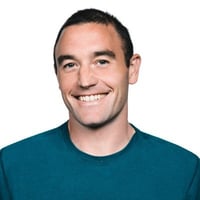
Kevin Weil is the VP, OpenAI for Science, previously Chief Product Officer at OpenAI, where he leads the development and application of cutting-edge AI research into products and services that empower consumers, developers, and businesses. With a wealth of experience in scaling technology products, Kevin brings a deep understanding of both consumer and enterprise needs in the AI space. Prior to joining OpenAI, he was the Head of Product at Instagram, leading consumer and monetization efforts that contributed to the platform's global expansion and success. Kevin's experience also includes a pivotal role at Twitter, where he served as Senior Vice President of Product. He played a key part in shaping the platform’s core consumer experience and advertising products, while also overseeing development for Vine and Periscope. During his tenure at Twitter, he led the creation of the company’s advertising platform and the development of Fabric, a mobile development suite. Kevin holds a B.A. in Mathematics and Physics from Harvard University, graduating summa cum laude, and an M.S. in Physics from Stanford University. He is also a dedicated advocate for environmental conservation, serving on the board of The Nature Conservancy.