
From8:00 PM
To8:02 PM
GMT
Tags:
Opening
Opening Remarks
Speakers:


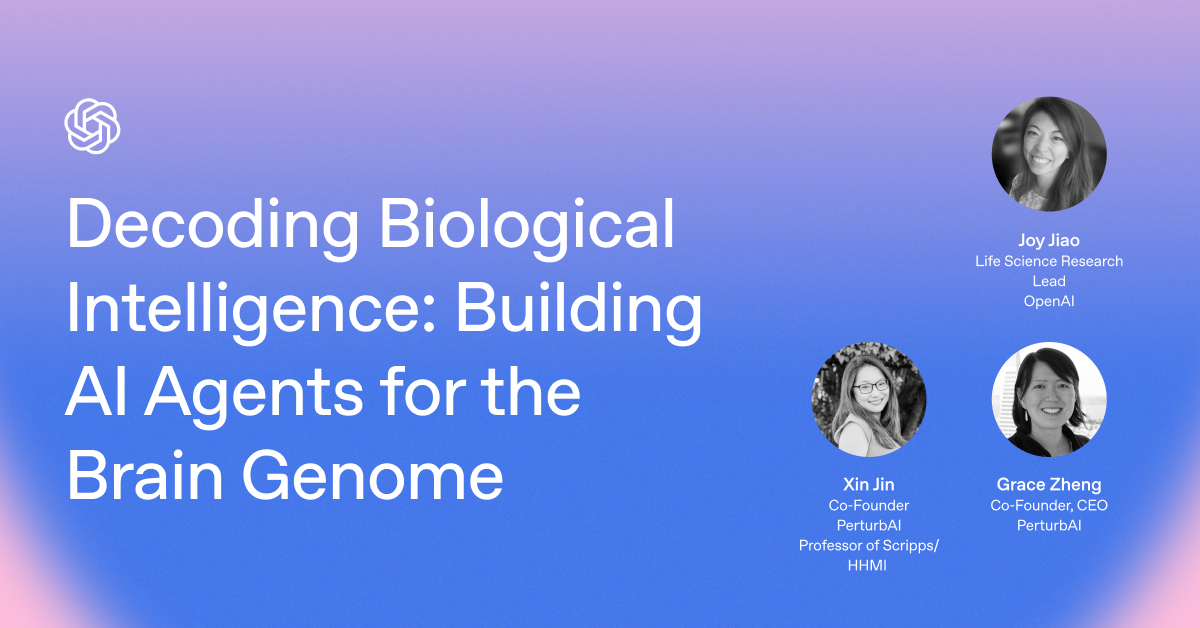
Grace Zheng, co-founder of PerturbAI, and Xin Jin, co-founder of PerturbAI, and Professor of Scripps/HHMI, will show how we’re moving from mapping the brain to predicting how it works. In partnership with OpenAI, they’ve built one of the largest brain datasets ever created, capturing activity across 8 million cells, and are using AI to uncover the rules that drive biology.
The result: a new era of biology and medicine that is more predictive, more precise, and far more effective.
Zheng and Jin will also demonstrate how AI is transforming science itself, replacing complex, manual workflows with systems that let researchers explore data using everyday language, to help accelerate discovery and open the door to many more contributors.
They’ll even introduce the idea of a “digital brain”, a simulation that could allow scientists to test treatments virtually, understand disease at its root, and bring life-saving therapies to patients faster than ever before.
Xin Jin is a neuroscientist and molecular biologist whose work lies at the intersection of in vivo functional genomics and disease biology. She is an Associate Professor in the Department of Neuroscience and the Dorris Neuroscience Center at Scripps Research, and an HHMI Freeman Hrabowski Scholar. Her lab develops scalable in vivo genomic technologies to uncover how genetic programs shape brain circuits across development, homeostasis, and disease. She recently co-founded PerturbAI to help bring this vision into therapeutic discovery.
Her work has pioneered in vivo Perturb-seq, a high-throughput approach that combines pooled CRISPR perturbation with single-cell readouts directly in living tissue. By integrating in vivo CRISPR screening with molecular, spatial, and whole-brain imaging approaches, her research aims to define how genes influence cell types, tissue architecture, homeostasis, and neural circuit function.
Xin’s contributions have been recognized by honors including the HHMI Freeman Hrabowski Scholar Award, Sloan Research Fellowship, Pew Biomedical Scholar Award, McKnight Scholar Award, Peter Gruss Young Investigator Award from the Max Planck Society, and MIT Technology Review’s Innovators Under 35. Before joining Scripps Research, she was a Junior Fellow in the Harvard Society of Fellows. She received her PhD in Biology from The Rockefeller University and her BS in Chemistry from MIT.
Grace Zheng is a genomics and machine learning leader with over 13 years of experience developing breakthrough platforms at the intersection of biology, data, and therapeutics.
She is the Co-Founder and CEO of PerturbAI, an AI-native therapeutics company accelerating drug discovery through a systems-level understanding of disease. Her work focuses on integrating in vivo Perturb-seq with AI agents and models to map biological circuits directly inside intact organisms, enabling a new generation of biological models and therapeutics grounded in causal, in vivo biology.
Previously, Grace served as Vice President of Computational Biology and Machine Learning at ArsenalBio, where she built and led interdisciplinary teams spanning computational biology, machine learning, and software engineering. She also led strategic collaborations with partners including Genentech and NVIDIA to generate large-scale functional genomics datasets and develop AI models for cell therapy discovery.
Earlier in her career, she joined 10x Genomics as one of the company’s first employees, where she helped pioneer and launch several foundational single-cell genomics technologies.
Her work centers on building enabling technologies, scaling interdisciplinary teams, and transforming biological data into predictive models that guide the next generation of medicines.
Joy Jiao leads the life sciences team at OpenAI. The goal of the team is to accelerate basic research and drug discovery, by operating across the model training stack to improve model capabilities at all levels of biology, from molecules to organisms. At OpenAI, Joy previously worked on model safety, personalization, search, and representation learning. She holds a PhD in Systems Biology from Harvard, where she studied the in-patient evolution of cancer cells during immunotherapy as well as the evolution of antibiotic resistance.