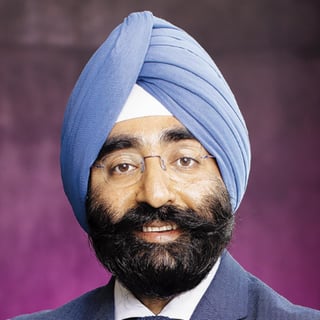
[00:00:00] Mark: Hello, everybody. Welcome to the Open AI Forum. I'm Mark Murray, Editorial Director here at Open AI.
[00:00:12] We're joined today by Sarah Friar, Open AI's Chief Financial Officer, and Jagdeep Friar, Chief Investment Officer at the University of California. Today's conversation comes at a fascinating moment for finance. Sarah and Jagdeep will talk about how AI is changing finance work, what kinds of tasks AI can help with, and what skills are becoming increasingly important.
[00:00:39] I also wanna give a quick shout out to the UC students tuning in today. We're excited to have UC students interested in finance careers joining us along with our forum community. And with that, I'll turn it over to Jagdeep, who will interview Sarah for this conversation.
[00:00:54] Jagdeep: Sarah, thank you for agreeing to do this.
[00:00:57] Sarah: My pleasure.
[00:00:58] Jagdeep: I'm very excited too, 'cause we have with us a lot of students from the University of California, a very important group of individuals that are thinking about the future with AI. And I thought who better to have a conversation around AI and finance than yourself? To start with, before we get into more detailed questions around the benefits and all the opportunities that come around with AI, let's start with your career. How did you get interested in finance and ultimately get to this very important role in finance?
[00:01:31] Sarah: Well, first of all, hello, students. I'm super excited to be talking to you today as well as the mom of teenagers—well, not even a teen; I have a 21-year-old now. It is an incredible time in your life. I'll take the clock back a little, but I will not, I'll make it short. I grew up in Northern Ireland during the troubles—not the best time, but a very unique time. I was always super curious as a kid. I was the kid that took my mom's vacuum cleaner, the Hoover, apart and never figured out where the last screw would go, but clearly recognized that it had been overbuilt. It didn't need that last screw; it still worked. I thought that would turn me into an engineer, and that was the path I took.
[00:02:26] I was an engineer in college, but right ahead of college, I had to figure out a way, frankly, to pay my way through college. So I took a year out working for Arthur Anderson, and that took me into the world of finance. I was a training accountant effectively for that year when I was 18 to 19, and then Arthur Anderson sponsored me through college. So I got to go in every holiday and work in different parts of their organization, which took me through everything from tax to consulting. They even had a bankruptcy division that I spent a summer in. It was really a fascinating way to learn about finance.
[00:03:03] That said, I kind of exited college with my shiny bright master's degree in material science and thought I would still do this world of more engineering. Careers are long and also quite zigzaggy; they're never the straight line that you expect. So I ended up going to McKinsey, which sent me off to South Africa. I was the only young BA at the time that had spent any time in the mining industry, of all things, because I wrote my thesis on how to extract gold out of sulfide ores. Hence, with McKinsey, I got this wonderful purview into how businesses really work. I feel so grateful for that time.
[00:03:43] After that, McKinsey sent me to business school, which brought me out here to the West Coast. I will not say where I went because you'll all boo me, but I came out to Stanford for two years. I'm sorry.
[00:04:03] Jagdeep: Okay. I shouldn't have asked you that.
[00:04:06] Sarah: I spent two years on the West Coast and then stayed. I joined Goldman, really got to learn about banking and equity research. I then realized I loved operating; I wanted to be inside a company. A very natural path, given my background, was into the world of finance. One of the best pieces of career advice I got at the time was I thought I was all ready to be a shiny, bright new CFO. I went and had lunch with a headhunter who, at the end of lunch, said, "You have no business being a CFO. You don't even know what a CFO does." I was very taken aback, and by the way, there are good moments in your life where someone calls you on it. They said the best thing you could do is go work for a great CFO and learn the tools of your trade.
[00:04:50] So I joined Salesforce and I worked for an amazing CFO, Graham Smith—an incredible individual, great mentor, great coach, great friend. I really learned...
[00:04:58] Mark: Coach, great friend. And I really learned enough at that point to eventually project myself into Square, where I was the CFO of Square, became CEO of Nextdoor, and then finally the CFO of OpenAI. So I tell the story a little bit more long because I think it's good to see that you start out thinking you're going one direction. You may end up pivoting, but always think about what are the primitives or what are the basic skills you're learning along the way? What are you great at? What gives you pleasure? What actually can pay the bills and try to bring all of those things together?
[00:05:29] Jagdeep: Incredible. Now, did you want to be a CFO? Or was that the headhunter challenging you to become a CFO?
[00:05:33] Mark: No, at the time, I think when I came out of Goldman, everyone kept telling me, oh, you've been an equity research analyst, you should go be a CFO. And it sounded like a really good title. And this is like another good learning in your career life, like, don't get enamored of titles or what other people think. First of all, when I left Goldman, I felt like I had to go do something and CFO sounded like I'm doing something. Sounds cool. I'm like, why? And it was because other people might look at it, I don't go do that. Nobody cares, like the good news is we're all the protagonist in our own movie and everybody else is watching their movies, no one's watching your movie. So never do things because of what you think other people will think. I think the other reason the headhunter said that though, at the time, was truly like, I didn't know what a CFO did. I thought I knew from the outside and seeing what someone's job is like. When they tell you the external facing things, it is very different from the guts of the operation. And so getting inside a company and seeing what operators do, that is the best way to learn.
[00:06:41] Jagdeep: Incredible. Now you're having conversations at dinner with your kids, those that are at home and some on the phone call, what are the discussions around careers and ambitions and jobs and the impact of AI to the future of young Americans?
[00:06:57] Mark: Yeah. So, I mean, I'm right in this right now with probably the folks listening on the call here on the webinar. My daughter's a junior in college, my son's a freshmen. So we talk about this all the time. I've got one home at the moment, which I'm excited about, one about to come home. I use three words when I talk about thinking about AI, career, future. Number one is curiosity. Number two is adaptability. And the third, I will always say to everyone, which is kindness, which is probably an unexpected third in some ways. The first is curiosity. Dive in, try stuff. Don't be afraid of things. Like fear usually comes when we don't understand or we're not sure what something will be. I face this every day at work, right? We live in an environment at OpenAI where we probably launch something new every single day. And I can have that feeling after a few weeks where someone in the org will ask me, am I using XYZ or have I tried this other thing or have I downloaded a skill in Codex? And I can almost feel the fear in me coming forward because I'm like, oh my goodness, I don't know what they're talking about. And then I go off and I try to download it and the thing doesn't work. And I remember coming to work right after I started using Codex, which is our agentic platform, and kind of saying, we need to get some of my IT to come, I tried this and it didn't work. And my assistant, my EVP actually turned to me and said, did you just ask it to fix itself? And I was like, what are you talking about? And he's like, just say, please fix yourself. And it's like magic. And it did. Wow. And so I think this is a big shift by the way in using technology. We're being able to ask the technology to help you use the technology, whether it's to fix itself or to suggest ways to use it. That is such a night and day change from when I was taking my mom's vacuum cleaner apart and it was not telling me where to put the final screw back in again. So huge change just in how we use and feel and intuitively work with technology. So curiosity, number one. I think we've always been very curious by nature. And so I think now of back in Northern Ireland when the man showed up at our front door and sold my parents the Encyclopedia Britannica was like the best day of my life because I lived in a place where there wasn't a ton of ways to educate yourself. All of you on this call right now, you have access to not just the Encyclopedia Britannica but like so much knowledge. That making use of that I think is such a gift.
[00:09:31] Jagdeep: Second is adaptability. Trying to talk with my kids right now about the career for them, I'd be like my parents trying to talk to me about my career. My mom grew up on a farm, she was a nurse. My dad, his dad was an electrician and she came to Northern Ireland to put up the electricity wires, which I think is a really cool arc thinking about AI. And you need a lot of that right now. You do. But think about what it was like.
[00:09:56] Mark: But think about what it was like when the lights turned on for the first time in someone's house. I think there's a really strong analogy here. Both of them left school at 16. They're amazing parents. They are the most amazing community people. I'm so grateful to them. But them trying to give me career advice was just not happening, because they didn't know. They wanted me to be a doctor, which they understood, but every other career, they weren't really sure about. And so I think that's somewhat true today. As we try to give our kids advice on their careers, AI is changing a lot. I'm not in binarisms. I neither believe that AI will have no impact; don't worry, we'll all be fine. Everything will be steady as she goes. And I also don't believe AI is gonna take away all of our jobs. Our economic research team has actually done a very good piece of research that suggests it's much more. There are some jobs that will probably get usurped by an agent, and many of those jobs probably should because they're jobs that were very routine and mundane. There are jobs that are absolutely gonna change. My job is night and day different, even a year on from starting to use agentic outcomes in my work. And then there are jobs that we cannot even imagine that haven't been created yet. Like my mom couldn't imagine my job. My grandmother worked on a farm; she definitely couldn't have imagined what I do today. And so I think that adaptability is key. And then I'll just end with kindness. I do think that no matter what you're doing in life, like learning to be kind, to be empathetic, like in the end, I think so much of humanity, like it's a repeated thing. It comes around over and over again. Like helping people before they, you know, they're not giving you anything but you're doing something for them. I think in your life, you will be shocked how much it pays back to you over and over again. If you're a young student right now sitting in college, you're coming into the workforce for the first time; do not underestimate the power of just doing something kind for someone. Along the way, it will return in bucket loads to you. So those are my three words that I drive home to my kids and I hope folks listening maybe take something away on that front.
[00:12:12] Jagdeep: Incredible. Can I just dive in on fear for a moment? Is there one thing you would suggest as a tip on how to overcome one's fear on embracing AI?
[00:12:25] Mark: So I have one of my kind of rules of the road for how I feel about my life is about adrenaline. And when I, when you're afraid, you get that adrenaline rush; I actually like getting an adrenaline rush. My brother is an ER doctor. He actually did what my parents wanted to, became a doctor. They understand what he does. My wife is an ER doctor. And he's amazing. They're built from different material than the rest of us. He always says like in the end, if it's all going poorly, what do they do to bring you back? They stick a needle of adrenaline into you. And that's like part of trying to shock the system back into moving. So if you want to feel alive, feeling that adrenaline rush. So usually when I find myself in a moment of fear, I actually try to flip it back to number one, oh, feel that adrenaline. I'm alive. And number two, how can I harness this moment of what I'm feeling and try to turn it into something positive? And I feel this all the time, right? I had to give a talk yesterday morning, I think. I don't often get a ton of adrenaline when I'm presenting, but this was like, it felt like a higher stakes moment. And so in that moment, right before I take the stage, it's a really good moment to feel the adrenaline rush. And frankly, in my head, what I'm thinking in those moments is usually, it's a little off topic, but bear with me for a second. There's just not that many women on stages right now in tech. And so I'm gonna take my fear and my adrenaline rush, and I'm gonna do this because you cannot be what you cannot see. And so I'm gonna go out and do that pitch, do that stage show, because I just think it's good to show diversity in technology. So it's a very minor example of how I try to harness fear and how I try to kind of work through it by just taking myself out of the equation a little bit and thinking about a greater good, a greater moment that I can create with that fear.
[00:14:19] Jagdeep: Thank you for sharing that, especially on recognizing those that might not feel like they're represented in the audience. Now, where do you see AI enabling people to do more, particularly in the finance industry? Since that's the focus today.
[00:14:34] Mark: That's what we do. There's so much more we can do. Yeah, so on the finance side, what we have really seen happen in my finance world here at OpenAI is we're pushing ourselves every day to become the company of the future, beginning with finance. That is one of our core objectives. So about two years ago when I joined.
[00:14:54] Mark: About two years ago when I joined, we started small. So we were using at the time, chat GPT and custom GPTs. We were using them in small and big ways. One of the things I did for my team was to create hackathons. So every quarter, we would create some space for the team to slow down to go fast, because when I would poll people, I’m like, why aren’t you using this new tool? They were like, I don’t have any time to learn it. I’m too busy getting my work done. And that to me is always symptomatic of people who actually need a breath to slow down, so that then they can come back and use tools that will accelerate them. So that was the beginning, those hackathons. One of my real magical moments is we were in the middle of a big fundraise. We created a custom GPT for investor relations. What we did is effectively fed chat GPT all of our materials. So our company presentation, all of the diligence materials we’d created, we started to update it. And then very quickly, we have at our fingertips a custom GPT that helps us answer any investor questions. So all those answers you got that you felt were so good, they were coming from our custom GPT.
[00:16:04] But that aside—without any hallucinations. Well, it’s really important to give the, whatever, if it’s our agent’s day, or to give your memory a lot of direction about things that you don’t want it to do or say. Like in the case of our IR GPT, we want it to be very factual, a little salesy, but not too salesy, right? We want it to have a positive personality, but not to go into mass sales mode. Because with investors, we want to be very high integrity, you know, very on the mark. We also want to make sure that if it doesn’t know, that it just says it does not know, which is the best piece of advice I ever got as a CFO on an earnings call was to say, I don’t know, but I will follow up. So I try to give my custom GPT that personality.
[00:16:54] I will run the clock forward to about a month ago, I was in South Korea in an investor meeting, and when I walked in the door, they presented me with two pages of questions in Korean. So I pulled my phone out, which had my custom GPT on it, snapped a photograph, and I asked it to just give me the answer. So of course, it knew to translate, gave me all the answers. I actually wanted to then have chat GPT talk back in the meeting in Korean. My translator wanted to make sure that we still went through the translator, but we are inches away from being able to just communicate in a bi-directional way, English to Korean and back, so that you can have a very fruitful conversation with an investor utilizing my IRGPT.
[00:17:39] That was a very early example. But today we are really going AI native in the finance world. So making sure that every process we do, right? When you’re a CFO you’ll start to hear these terms like quote to cash, order to payment, equity, tax, treasury, right? These are kind of the building blocks of any strong finance organization. And so within each of those, we look at what are the core tasks each is trying to do. And then we’re constantly looking for ways where we can embrace our own technology to make us more productive, more insightful, do things faster.
[00:18:21] Even with our accountants, I’ve been spending a lot of time talking to them about something that I learned back when I was 18, 19 years old, which is most accountants when you’re doing an audit, you do something called sampling. And why do you do sampling? You do sampling because there’s not enough people in time to actually go read every single invoice, for example. So you instead say there’s 1,000 invoices in this period, I’m gonna sample 10. And if the 10 I sample are what I expect to find, then I’m gonna check this audit. I expect now that the other 990, did I say 1,000, are correct. But you do that because you live in a world of scarcity, scarce resources, scarce people, scarce time.
[00:19:09] In a world of abundance, which is what AI brings us, the agent can actually check all 1,000 invoices. And so it really kind of starts to shift the control. I actually think it will make controls and precision and so on much stronger. I’ll give you one other example. So in our tax team, our tax team is probably our most AI pill team, which is funny, because tax people are often your most conservative, but we’ve done something magical here at OpenAI. Our tax team loves our tools. One of the things they have to do at the end of every tax year is they have to think about all of the tax forms that we need to fill in and put in every tax department in the world. We’re a very global.
[00:19:52] Mark: We're a very global company. Today, only 10 percent of chat GPT weekly active users are in the United States, so 90 percent are outside the US. Our fastest growing continent right now is Africa, for example. So, imagine what it would be like without the use of our own technology. You would have people whose job would be to go to the IRS websites or the equivalent, the inline revenue, if you're in the United Kingdom, to go scour through to find the tax form. And these things have a sneaky habit of changing slightly every year. So, you might think you've nailed it, and then they'll add a new box somewhere. So, now it's going to pull that down, usually in a PDF. It will understand the shape of the form. You can give it the data on the other side of like, here's what we all calculated as tax people, but the mundane task is the writing it in all the right boxes. So, today, we have now totally automated that. So, every tax form in the world is automatically pre-filled, which means that my tax team moves into checking mode. So, I've saved them a lot of time. And ultimately, as we get more and more confident, our hope is we can even just file in an automated way, which gives the tax team more time to spend on, are the numbers correct? Are we doing the right thing for the business? Are there some interesting new ways that we could present our taxes? To do what they went to school for, the people on this call, but you all are not in school right now to learn how to fill in PDFs. I think that is a really interesting shift in my world, and I could give you hundreds of examples like that.
[00:21:34] Mark: So, at UC Investments, we have our culture, which is the UC Investments way. And the first pillar of it is less is more. And as I'm listening to you, it sounds like you can do so much more with a lean and a small team. How many people do you have on the finance team for such a global enterprise with over a billion active users?
[00:21:55] Jagdeep: Today, we are, finance team is probably about 200 people-ish. Incredible. In that zone, yeah, we are quite lean. Now we also though are in certain areas probably bigger than maybe a normal finance team. And that comes back to, with the technology, we can drive a lot more insights. So, for example, in my finance team today, I have an economic research team. I have a pricing team. This often will not sit in the CFO's world, because the CFO is overloaded with all the other things. But actually I'm able to grow in certain areas where actually deemed there being a lot of room for real insight. So, economic research is a great example where I would normally put an, I've never had an economic research team as a CFO. But it kind of now helps me use my old research learning when I was at Goldman Sachs, and pair that to the fact that there's so much curiosity in the world right now about what's happening with AI, paired with the fact that we at OpenAI have access to a lot of data, and being able to kind of create insights that help us with investors. They help us with customers. They help us with just the curious. And so if you all have a minute in your day, you can send your agent off to find the OpenAI Economic Research Team's blog posts, and I highly recommend them.
[00:23:15] Mark: Incredible. Now, the ninth pillar is human meets machine. And you've described fundraising and all these incredible tools that helped. What's one thing that hasn't changed in the fundraising process with AI?
[00:23:36] Jagdeep: So certainly for now, I still believe one of my mantras on fundraising is in the end, people invest in people. And I think it's so much about trust and integrity. When you came to visit, our breakthrough moment was just the fact we stood in the same room together. And if I recall at the time, you brought in your amazing book of values, by the way, which I have sitting in my office right now, say office, my room, I don't really have an office. You just have a desk. And I love it, I have a desk. Way to go, people, that's what you've got to look forward to. And standing only. You will become the CFO, and you will get be granted a standup desk. But what I loved about that moment is, I remember in fundraising, it's not about the money that you get. Money is important to run your business, but it's the people you surround yourself with. Because those people don't just bring you money, they bring you many, many other things. They teach you, like your book teaches me, the way you've shown up in the world teaches me. The fact that you said, I want to come in and help you think about how do you talk to a large scale.
[00:24:50] Mark: To a large-scale educational establishment, like the UCs. He said, you know what, we could do like a podcast. It'd be super fun, we're doing it right now. And that's what has not changed to me for fundraising. And it's why I've always put kindness in one of my top three because I think when you treat people well, when you take the time to get to know them, in the moment you might not, I didn't know if we were going to raise money from you all. I didn't know if you'd want to invest in us. I didn't know if you'd be the right investor for us on the other side, but it's a long game and you may find not in that moment, but maybe it's in six months or in a year, or maybe it's in five years, but it's incredible how many people come around in your career again. And I think the human to human has not changed for me. I should've just sent it two years prior when I actually had a chance to meet Sam Altman for the first time and he had said, this is a great opportunity.
[00:25:50] Jagdeep: Now, what advice would you have for students and universities as they're growing their talent and their pipeline of future OpenAI employees, future contributors to the economy? What skills do they need to learn?
[00:26:01] Mark: Yeah, so first of all, we work with a lot of universities around the globe. I do think the UCs have been really ahead of their time and we're really appreciative for the fact that you do work closely with us. Our EDU team under Liabelsky is phenomenal. We have a program called the GENAI Next program where we've gone out to work with many establishments around the world. One that's near and dear to my heart is Oxford, which was my alma mater from my undergrad. We've done a bunch of work with them with the Bodleian Library, which is I think the oldest library in the world, certainly one of the biggest. And are there ways to bring back manuscripts from like the 1400s or whatever and actually understand them? So I think for universities, one piece of advice is just, you know, deploy and be curious and learn. And as I say, with enterprises as well, sometimes you have to kind of let a thousand flowers bloom first and let people experiment before you try to lock it in. So that's kind of one piece of advice.
[00:27:03] I think the second thing is, frankly, you know, how are you going to AI-ify your classes? I push teachers on this all the time. I think there was original fear of, like, students are going to go around cheating. I remember having a wonderful conversation with the head of Georgia Tech. And he said, you know, he had this moment where his head of admissions had run in the door and said, oh my goodness, they're all going to cheat on their admissions essays. And he was like, what are you talking about? They already cheat. And the guy was like, stopped in his tracks, like, what do you mean they're cheating? He's like, well, you know, if you're wealthy enough to go get the counselor or your good neighbor down the street is helping you, is that cheating? Or is that just using the resources at your fingertips? So in this case, our job is not to try to call people out for cheating, but instead to set admissions essays that really tell us about the students. And if they're using ChatGPT to help with that, we should encourage that because that shows they're curious and they're using the tools at their fingertips.
[00:28:05] So I think the same is true for in-classroom participation too, is how do we utilize the tools to keep extending the thinking without having people cheat themselves? Which is, you still have to learn how to think. Like my daughter, as I said, is a junior, she's doing chemistry. I see her working all the time with Chat because she'll say, instead of waiting for my TA on a Monday morning to help me solve this problem I'm stuck at, if I can keep going when I'm in flow, that's a good thing. And in the end, I have to take finals and I can't use Chat then. So it's helping me to learn, but in the end, I have to show that I have actually reached a degree of mastery. So I think that's the second thing. One is experiment, two is really kind of try to shift it into how to make it AI native.
[00:29:47] And then I think the final thing I would say is it's not, in some ways, like there was a lot of concern back in the day about radiologists, and people have talked about that over and over again. That somehow, particularly at the time, machine learning would take all radiologists out of the world. There's more of them today than that. It's the famous study. But even, I was looking at software engineers recently, there are more software engineers now since 2022 when ChatGPT arrived. I think the software engineer population is actually up about 6% since then, despite the, you know, there's a lot of chatter about its demise. In reality, what's happening is many more people can do things like develop code than could before, right? I did code development back in my teens and twenties as an engineer, but on Cobalt. So I come to work now and I'm like, I wish I could code. You know what, I can code again, it's super cool. So I think it's like teaching people not to be fearful, to embrace it, to experiment, to learn how to be AI native, and then also just to be curious about what's next, like what are the new programs?
[00:29:48] Mark: What's next? Like what are the new programs that universities might not have put in place? I think there's a lot of space right now for cross-disciplinary outcomes as well. Incredible. Now look, when I came to meet you a few months ago, you were in the middle of raising a hundred billion dollars.
[00:30:06] Mark: $122. I had run my chat GPT model on should I invest, but candidly not until when I showed up and I met you in person. The energy, the excitement you had, the fact that you were curious about who we are and actually understanding our culture and our institution and what it meant to OpenAI. All of those things as soon as I left here gave me the excitement to want to be an investor in OpenAI. But also recognizing there's so much OpenAI in partnership with the UC can do for the future of students.
[00:30:41] Mark: We both get to meet a lot of great investors, CFOs, leaders. You've always been kind, and I've only met you know twice before. This is the third time. But your kindness comes through. Your gratitude is heartfelt and genuine, and I really appreciate it. I would say in addition to this being a great company, it's great to have you as the CFO and the leader of the institution. So thank you for doing this today and hopefully to all the UC students, this was just part one of another podcast or a conversation we can have. I feel like we're just getting started, warmed up.
[00:31:18] Jagdeep: We are.
[00:31:19] Mark: So thank you very much.
[00:31:21] Jagdeep: Yeah, appreciate it. Wonderful. Back to you, Mark.
[00:31:24] Sarah: That was awesome. Thank you for that great conversation, Sarah and Jagdeep. We appreciate everyone taking the time to tune in, including the UC and OpenAI forum community. We hope you join us for our future upcoming forum events. This Thursday, we're hosting our chief economists and partners from Bain and Company for a discussion on enterprise AI adoption. Then next Tuesday, we're hosting the Brooklyn Sports and Entertainment, the owners of the Brooklyn Nets, the New York Liberty, and Barclays Center for a conversation on how they deploy AI internally.
[00:31:55] Sarah: And we're going to be dropping in links to register for upcoming events. We hope to see you back at the OpenAI Forum very soon.